
Flash without the cable.
Choose a ROM ZIP or an image on your computer. Transfer it over Wi-Fi, review it and install it from the browser.
Built into AERA Recovery
Flash ROMs, manage files, back up your phone and open a recovery terminal directly from your browser. Over Wi-Fi or USB. No desktop app required.
The browser workspace
Review the target. Confirm the operation. Follow the progress.
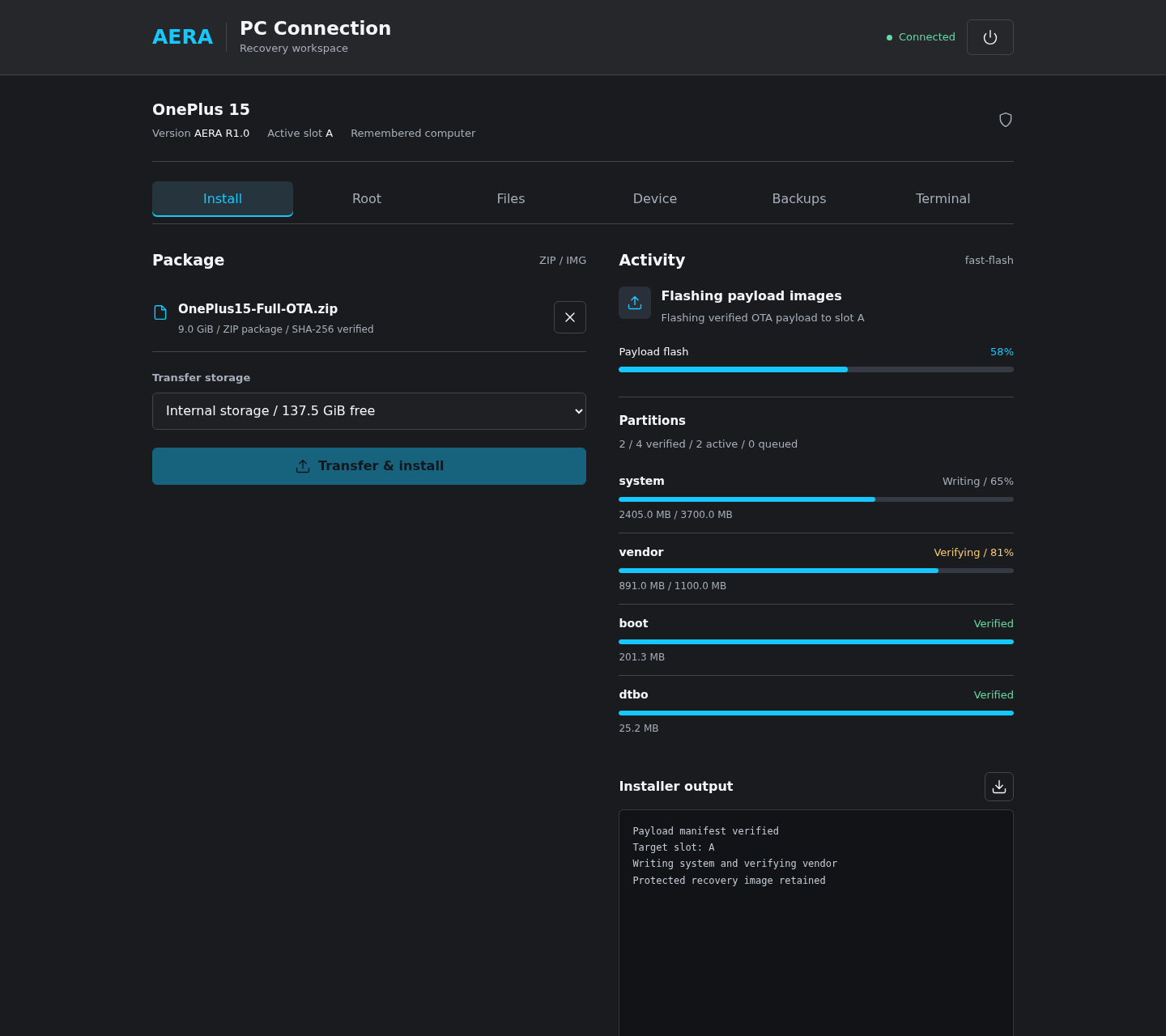
See which partition is being flashed, with live write and verification progress.
Actual interface, example data. Open the image for full size.The complete picture
Flashing, files, root, terminal access and diagnostics — explore what the browser workspace makes possible.
Choose a ROM ZIP or an image on your computer. Transfer it over Wi-Fi, review it and install it from the browser.
Stream a recovery backup straight to a folder on your computer, then restore it from there. Computer backups are Beta.
A dedicated browser workspace for files, root, backups, a live terminal and diagnostics. Real recovery tools, built for your computer.
Review ZIP metadata, target slot and rollback information before installing. Choose the standard installer or experimental fast payload flashing. Select partitions or extract images from supported payload ZIPs, with applicable preservation options. With Wi-Fi connected, AERA can also download a ZIP or IMG from a direct link before installation; download pages and sign-in links are not supported.
Upload multiple files, create folders, rename and delete entries. Save files or whole folders to your computer, select entries for batch actions, or install a ZIP or image already on the phone. Folder downloads use a supported desktop browser's folder picker, without creating a ZIP on the phone. Follow uploads on either screen and cancel from either side.
On builds with Root Manager enabled, inspect either slot, find matching KernelSU, KernelSU Next or SukiSU Ultra releases, patch the target, restore a root backup or install the manager APK.
Open an interactive root shell in the Terminal tab, with full-screen mode and tools such as htop. Inspect processes, read logs or run recovery commands through the same approved Wi-Fi or USB connection. Commands run on the phone, not on your computer, and have full recovery privileges.
Set up SMB or SFTP from the Backups tab and save the connection in recovery. SFTP supports passwords or private keys. Use available internal storage, USB drives or mounted network storage for both recovery and App Backup Vault backups, instead of streaming to the computer.
Check battery, memory, kernel and slot information. Download recovery, Logcat and kernel logs, or the automatically captured flash-log ZIPs for an installation bug report. Reboot to Android, recovery, the bootloader or fastbootd where supported.
Backup and restore
Choose Recovery for native partition backups or Apps for App Backup Vault. App backups require the Vault plugin and accessible data for the selected Android user. Save to this computer, internal storage, a mounted USB drive or network storage. The destination is independent of how you connected: Wi-Fi and USB expose the same tools.
Pick a local folder in a supported desktop Chromium browser and keep the page open. AERA streams authenticated blocks directly to or from that folder while showing transferred MB and the current MB/s rate. Device-storage backups remain available without browser folder access.
Restore a native backup or encrypted App Vault snapshot directly from the computer, or transfer the complete source to device storage first so the restore can continue without the browser.
Follow the same operation on phone and computer, including the final file-save step. Cancel backups from either side; stopping a restore requires additional confirmation and does not undo data already restored. Interrupted native computer backups stay marked incomplete. Native checksum preferences and Vault integrity checks use the existing recovery engines.
Keep the browser connected and check that the operation finishes successfully. A disconnected direct restore can leave partially restored data; stay in recovery and complete the restore before booting Android.
Direct and approved on the device.
Your browser connects directly to recovery. New browsers need physical approval, and the device stores only a browser key fingerprint, not a plaintext secret.
Started installations continue if the browser disconnects. Direct computer backup and restore require the approved browser to remain connected.
Open the connection guide